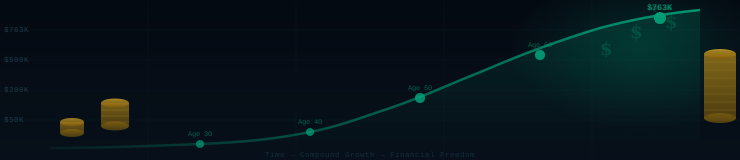
Start Investing at 16: How $20 Per Paycheck Becomes $763,000
A 16-year-old investing $20 per paycheck in a Roth IRA can reach $763,000 by retirement - on just $90,480 of total contributions. Here's the complete math, milestone by milestone, and exactly how to start.
You just got your first paycheck. Maybe it’s $280. Maybe $340. You’re 16, and retirement is the last thing on your mind.
Here’s what nobody tells you at 16: the money you invest right now is worth more than money you invest at any other point in your life. Not a little more. Mathematically, life-changingly more.
The reason is compound interest - and starting at 16 puts you at the most valuable starting point on the compound curve.
Let’s run the numbers all the way to age 66. Every dollar. Every milestone.
The Plan Assumptions
- Return rate: 8% annually, compounded monthly (conservative S&P 500 historical average)
- Contribution schedule: biweekly - every paycheck, 26 times per year
- Starting amount: $0 - contributions only, no inheritance or lump sum
- Account: Roth IRA (tax-free growth - details below)
The base plan: $20 every paycheck starting at 16, with disciplined increases at key life milestones.
The Tiered Investment Schedule
| Age | Biweekly | Monthly Equivalent | Annual |
|---|---|---|---|
| 16–19 | $20 | $43 | $520 |
| 20–29 | $40 | $87 | $1,040 |
| 30–39 | $60 | $130 | $1,560 |
| 40–49 | $80 | $173 | $2,080 |
| 50–65 | $100 | $217 | $2,600 |
These aren’t aggressive numbers. $20 is one tank of gas. $100 biweekly at age 50 is $200/month - less than most people spend on streaming services and dining out combined.
The Math: Age 16 to 66, Milestone by Milestone
Age 16 → 20: $20 per paycheck, 4 years
You’re investing $520/year. You won’t notice it’s gone.
After 4 years at 8%: ~$2,500
It feels small. That’s fine. The power isn’t what this money is at 20 - it’s what it becomes over the next 46 years without you touching it.
Total contributed: $2,080
Age 20 → 30: $40 per paycheck, 10 years
Better job. Raise. Maybe a degree. Double it to $40 biweekly - still just $80/month.
The $2,500 from your teens compounds on its own, growing to $5,500 by age 30.
Your new contributions over 10 years add another $15,800.
Balance at 30: ~$21,300
This is when compound interest starts to feel real. Your account earned $12,700 in interest on top of everything you put in.
Total contributed: $12,480
Age 30 → 40: $60 per paycheck, 10 years
Life costs more at 30. Your income is also higher. $60 biweekly is under $130/month.
The $21,300 from your 20s doubles by 40, growing to $47,300 untouched.
Your new contributions add another $23,800.
Balance at 40: ~$71,100
You’ve personally invested $28,080 in your entire life. Your account holds $71,100. The market handed you $43,000.
Total contributed: $28,080
Age 40 → 50: $80 per paycheck, 10 years
$71,100 from your 30s more than doubles - growing to $157,900 by 50.
New contributions over 10 years: $31,700.
Balance at 50: ~$189,600
Nearly $200,000. You’ve put in $48,880 of your own money. Compound interest generated $140,720.
Total contributed: $48,880
Age 50 → 66: $100 per paycheck, 16 years
The $189,600 from your 40s grows to $679,300 over 16 years. Stop on that number.
New contributions add another $84,000.
Final balance at 66: ~$763,000
The Complete Picture
| Milestone | You Invested | Account Balance | Interest Earned |
|---|---|---|---|
| Age 20 | $2,080 | $2,500 | $420 |
| Age 30 | $12,480 | $21,300 | $8,820 |
| Age 40 | $28,080 | $71,100 | $43,020 |
| Age 50 | $48,880 | $189,600 | $140,720 |
| Age 66 | $90,480 | $763,000 | $672,520 |
You invested $90,480 over 50 years. The market generated $672,520 in growth. That’s a 7.4x return on every dollar you contributed.
What Happens If You Wait?
This is where the numbers get painful to look at.
If you start at 25 instead of 16 - same exact plan, just 9 years later: → Final balance at 66: ~$430,000
Nine years of waiting cost you $333,000. Not in lost contributions - in lost compound growth.
If you invest flat $20/paycheck from 16 to 66, never increasing: → Total invested: $26,000 → Final balance: ~$344,000
Pure consistency - no increases ever - still generates $318,000 in growth on $26,000 invested. The discipline of starting early and never stopping is worth more than optimizing the amount.
The Roth IRA: The Account That Makes This Even Better
The numbers above don’t even account for the Roth IRA tax advantage.
How a Roth IRA works:
- You contribute after-tax dollars (already paid taxes on this money)
- It grows completely tax-free
- You withdraw at retirement tax-free - no tax bill at 66
That $763,000 in a Roth? You keep all of it.
In a traditional 401(k) or taxable brokerage account, you’d owe taxes on withdrawals - potentially losing 20–30% at retirement. The Roth IRA eliminates that. If you want to see exactly how the numbers compare for your situation, the Roth vs. Traditional IRA calculator runs the side-by-side math.
2026 Roth IRA eligibility:
- Annual contribution limit: $7,000 (this plan contributes well under that)
- You must have earned income at least equal to your contribution - your first job qualifies
- Income phase-out starts around $150K for single filers (check IRS.gov for the current threshold - it adjusts annually)
- Under 18? A parent or guardian opens a Custodial Roth IRA at Fidelity or Vanguard on your behalf
Open one at Fidelity or Vanguard. Takes 20 minutes. Set up the auto-contribution. Then do not touch it.
The One Rule
There is exactly one rule that makes this entire plan work:
Do not touch it.
Not for the car. Not for the vacation. Not for the wedding. Not for anything.
A $5,000 withdrawal at age 30 doesn’t cost you $5,000. It costs you everything that $5,000 would have become - roughly $27,000 by age 66 at 8%. That’s the real price of “just this once.”
The money that makes this plan extraordinary is the interest compounding on interest for 50 years. Every dollar removed early breaks the chain.
Start Right Now
If you’re 16: Open a Roth IRA today. Put in $20 next paycheck. That’s the entire ask.
If you’re 25: Start today. You’ve already paid some of the delay cost, but the math still works powerfully in your favor for the next 40 years.
If you’re 35: Start today. The second best time is always right now. See how compound interest still works at any age.
Run your own numbers with the compound interest calculator. Plug in your age, realistic monthly contribution, and retirement timeline. The math will do the rest.
The only thing that beats compound interest is starting earlier. Since you can’t go back in time, the next best move is today.
Frequently Asked Questions: Teen Investing and Roth IRAs
Can a 16-year-old open a Roth IRA? Yes - but they need earned income from actual work, not gifts or allowance. If you’re under 18, a parent or guardian opens a Custodial Roth IRA on your behalf at Fidelity or Vanguard. The contribution limit is the lesser of $7,000 or your total earned income for the year. If you made $1,800 at a summer job, that’s your max for the year. Every dollar of that limit you don’t use by December 31 is gone permanently.
What should a 16-year-old invest in inside a Roth IRA? One broad index fund. VTI (Vanguard Total Stock Market ETF) or FXAIX (Fidelity’s S&P 500 index fund) - pick one, automate contributions, and ignore the rest. Low fees. No stock picking. No sector bets. The temptation to do something smarter will feel real; resist it. The boring choice consistently outperforms.
What if I can only invest $10 per paycheck - is it still worth it? $10 biweekly at 8% from age 16 to 66 becomes roughly $382,000 - on $13,000 contributed over a lifetime. Whether that answers your question depends on how seriously you take the math. The amount is almost never the limiting factor. Starting is.
Is a Roth IRA better than a 401(k) for a teenager? For almost all teenagers, yes. 401(k) accounts are employer-sponsored, which eliminates them as an option for most first jobs. Roth IRAs are individual - anyone with earned income can open one. The Roth’s tax-free growth is also most valuable when your tax rate is lowest, which for most teenagers means right now. The math on tax-free compounding from age 16 versus tax-deferred withdrawals at 66 is not close.
What happens to a Roth IRA if I need money for college? Your contributions - the money you put in - can come out any time, tax-free and penalty-free, because you already paid taxes on it. The earnings are a different story: pull those before 59½ and you’re typically looking at taxes plus a 10% penalty. There are limited exceptions, including some education expenses. That said, if you’re using this account for college expenses, you’re doing the math wrong. Leave it alone.