The 3-Portfolio Strategy: How Smart Investors Build Wealth in Any Market
Most investors keep everything in one bucket and wonder why downturns feel so devastating. The 3-portfolio framework separates money by purpose - growth, income, and safety - and changes how you respond to volatility forever.
Here’s a question worth sitting with: if the stock market dropped 40% tomorrow, which part of your portfolio would you sell?
If the answer is “I’m not sure” or “all of it’s in the same account,” you don’t have a portfolio strategy - you have a savings account that fluctuates with the market. That distinction matters more than most people realize until the market actually drops.
The 3-portfolio strategy is a framework for separating money by its job. Not by account type. Not by asset class alone. By purpose.
The Core Idea: Money Has Different Jobs
Most investors organize their money by where it is - IRA here, brokerage there, 401k at work. That’s an organizational view. The 3-portfolio framework asks a different question: what is this money supposed to do?
Portfolio 1 - Growth: Make you wealthy over the next 10–30 years. Accepts high short-term volatility in exchange for maximum long-term appreciation. This money’s job is to compound.
Portfolio 2 - Income: Generate consistent cash flow right now or in the near future. Lower growth ceiling, but produces dividends, distributions, or yield that you can spend or reinvest.
Portfolio 3 - Safety: Protect against catastrophe. This money doesn’t grow much. It exists so that when the other two portfolios have a bad year, you don’t have to sell them at a loss to pay your bills.
The reason this framework changes how you experience market volatility: when markets drop 30%, your growth portfolio is down - but your safety bucket is untouched and your income bucket is still generating cash. You don’t need to make an emotional decision under pressure because you built the structure before the pressure arrived.
Portfolio 1: Growth
What it’s for: Long-term wealth accumulation. Money you won’t touch for 10+ years.
What goes in it:
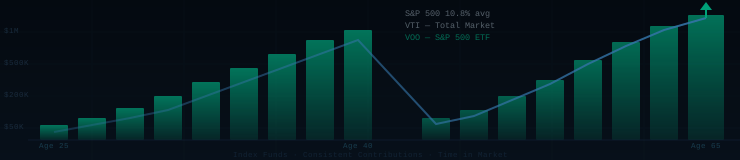
The core of any growth portfolio is broad market equity index funds. Not individual stocks, not sector bets, not thematic ETFs - broad indexes. The argument for this is simple: the US stock market has compounded at roughly 10% annually over the past century. Individual stock selection by retail investors consistently underperforms that baseline. The growth portfolio isn’t where you pick winners. It’s where you own the whole game.
Specific funds:
- VTI (Vanguard Total Stock Market) - entire US market, 0.03% expense ratio
- VXUS (Vanguard Total International Stock) - all international markets
- QQQ (Invesco NASDAQ-100) - tech and growth-heavy, higher volatility and higher historical returns over the past 15 years
A simple, durable growth portfolio looks like this: 70% VTI, 20% VXUS, 10% QQQ. You can hold this for 30 years without touching it and you’ll have captured the broad returns of global equity markets. Use the compound interest calculator to model what your specific numbers look like at different time horizons.
What it’s not: An emergency fund. Money you’ll need in under 5 years. Speculative bets.
Portfolio 2: Income
What it’s for: Generating cash flow - either to reinvest during accumulation or to live off in retirement.
What goes in it:
The income portfolio holds assets that pay you regularly. There are three main categories:
Dividend stocks and ETFs pay a portion of company earnings to shareholders on a regular schedule. They tend to be more stable businesses - utilities, consumer staples, established financials. The tradeoff is slower capital appreciation in exchange for reliable income.
Best-in-class dividend ETFs:
- SCHD (Schwab US Dividend Equity ETF) - screens for dividend growth and quality, not just yield. Current yield roughly 3.5–4%. One of the most respected dividend funds available.
- VYM (Vanguard High Dividend Yield ETF) - broader exposure, slightly lower quality screen, similar yield range.
Covered call ETFs generate income by selling options on stocks they hold. This produces higher current yield but caps your upside participation when markets run hard.
- JEPI (JPMorgan Equity Premium Income ETF) - yields roughly 7–9% depending on volatility, with lower drawdowns than pure equity
- XYLD - full S&P 500 covered call strategy, higher yield, higher complexity
REITs (Real Estate Investment Trusts) own income-producing real estate and are required to distribute 90% of taxable income to shareholders. They add real estate exposure without buying property.
- VNQ (Vanguard Real Estate ETF) - broad REIT exposure, dividend yield around 4%
An income portfolio isn’t about maximizing yield at any cost. A 12% yield that erodes your principal isn’t income - it’s return of capital disguised as income. Focus on quality first, yield second.
Portfolio 3: Safety
What it’s for: Capital preservation. Stability. The money that lets the rest of your portfolio run without you panicking during a downturn.
What goes in it:
The safety portfolio should never lose meaningful value. That rules out most bonds with long duration (which lose value when rates rise, as 2022 demonstrated painfully), and it rules out anything correlated with equity markets.
Best safety assets in the current rate environment:
- Short-term Treasury bills (T-bills) - 3-month to 1-year government debt, currently yielding around 4–5%. Zero credit risk. Purchase directly at TreasuryDirect.gov or via the BIL ETF.
- Money market funds - SPAXX (Fidelity Government Money Market), VMFXX (Vanguard Federal Money Market) - liquid, safe, currently competitive yields
- I-Bonds - inflation-adjusted savings bonds from the US Treasury, limited to $10,000/year purchase. Excellent long-term safety asset
- High-yield savings account - FDIC-insured up to $250,000, currently 4–5% APY at online banks
The safety portfolio is not exciting. That’s the point. It’s insurance.
How to Allocate Across All Three
There’s no single right answer. Age, income needs, risk tolerance, and existing assets all factor in. But here are starting frameworks:
Early career (20s–30s):
| Bucket | Allocation |
|---|---|
| Growth | 80–90% |
| Income | 5–10% |
| Safety | 5–10% |
Maximize compounding time. You have decades to recover from downturns.
Mid-career (40s):
| Bucket | Allocation |
|---|---|
| Growth | 60–70% |
| Income | 20–25% |
| Safety | 10–15% |
Balance growth with income generation. Start building the dividend base.
Pre-retirement (50s–60s):
| Bucket | Allocation |
|---|---|
| Growth | 40–50% |
| Income | 30–35% |
| Safety | 20–25% |
Protect what you’ve built while still growing.
The Buffett Indicator at 209% suggests US equities are historically expensive at current levels. That doesn’t change the long-term strategy - but it’s a reasonable argument for weighting the income and safety buckets slightly higher than usual, and increasing international exposure within the growth bucket.
Why This Works Psychologically, Not Just Mathematically
The best investing strategy is one you can actually stick to when markets go bad. And markets go bad. Regularly. The S&P 500 has dropped 20%+ on six separate occasions since 1980. It has dropped 10%+ dozens of times.
Investors who panic and sell during those drops lock in permanent losses. The ones who hold - or buy more - capture the recovery. The difference isn’t intellect. It’s structure.
When you know your safety bucket is three years of living expenses that won’t drop, and your income portfolio is still sending dividends, and your growth portfolio has 20 years before you need it - a 30% market drop becomes uncomfortable rather than catastrophic. You don’t have to sell. You’ve already decided in advance that you won’t.
That’s what the 3-portfolio strategy actually builds: a framework for not doing something stupid in the one year that matters most.
Frequently Asked Questions: The 3-Portfolio Strategy
What is the 3-portfolio strategy? It’s a framework that divides your investments into three buckets based on their purpose - growth for long-term wealth, income for cash flow, and safety for capital preservation. Each bucket holds different assets with different risk profiles. The goal is to eliminate the need to make emotional decisions during market downturns because your financial structure accounts for them in advance.
What should a beginner portfolio look like? For someone just starting out, a single growth bucket is completely fine - 80-90% in a broad US index fund like VTI or FXAIX, with 10-20% in international stocks via VXUS. The three-bucket structure becomes more relevant as your portfolio grows, income needs develop, and you start approaching retirement. Don’t over-engineer it early.
How much should I have in growth vs income vs safety? A rough starting point by decade: 20s and 30s → 80-90% growth, minimal income and safety. 40s → 60-70% growth, 20-25% income, 10-15% safety. 50s-60s → 40-50% growth, 30-35% income, 20-25% safety. Adjust based on your specific income needs and risk tolerance.
What assets go in each portfolio bucket? Growth: broad index funds (VTI, VOO, VXUS, QQQ). Income: dividend ETFs (SCHD, VYM), covered call ETFs (JEPI, XYLD), REITs (VNQ). Safety: T-bills, money market funds (SPAXX, VMFXX), I-bonds, high-yield savings. The key is that each bucket has a distinct job and holds assets that match it.
Can I implement this inside my existing 401(k)? Partially. 401(k) fund choices are limited by your employer’s plan, so you may not have access to every specific fund. Focus on building the growth bucket inside the 401(k) using whatever broad index funds are available with the lowest expense ratios. Build the income and safety buckets in your IRA and taxable brokerage accounts where you have full fund selection.