How to Start Investing With Just $100: A Complete Beginner's Guide
You don't need thousands to start building wealth. Here's exactly how to invest your first $100 - the right platforms, the right funds, and the step-by-step plan that actually works.
$100 feels small. It isn’t.
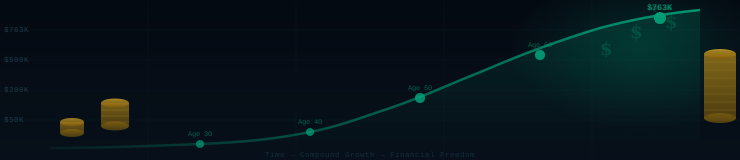
The reason it doesn’t feel significant is because we evaluate investments by what they are today rather than what they become over time. $100 invested at 8% annually from age 25 becomes more than $2,000 by age 65 - not because $100 is a lot of money, but because 40 years of compound interest is. And that 40-year clock only starts when you actually open the account.
This guide removes every obstacle between you and doing it today.
Why Small Investing Is Now Completely Viable
There was a time when investing genuinely required thousands of dollars. Minimum investment thresholds. Trading commissions of $7–$20 per trade. The complexity of managing individual stocks. All of it made small investing impractical enough that “start investing” was advice you could safely ignore until you had real money.
That barrier no longer exists. Commission-free trades are standard at every major brokerage. Fractional shares let you buy a piece of any stock or ETF regardless of share price - a $500 share becomes accessible for $5. Minimum balance requirements have been eliminated at Fidelity and Schwab entirely.
The math hasn’t changed, though. Compound interest doesn’t require a minimum deposit. It requires time. And every month of delay has a permanent, calculable cost.
Step 1: Choose the Right Account - This Matters More Than Which Fund You Buy
Before picking any investment, choose where to hold it. Account type affects your taxes for decades.
Roth IRA - the right starting point for most people
If you have any earned income from a job, open a Roth IRA before a regular brokerage account. Your money grows completely tax-free, and you owe zero taxes on withdrawals at retirement. On $100 that compounds to $2,172 over 40 years, the difference between a Roth and a taxable account can be hundreds of dollars in taxes saved at the end.
The 2026 contribution limit is $7,000 per year. You need earned income equal to or greater than your contribution amount. If you’re starting young, the math on a teenage Roth IRA is genuinely staggering - but the account structure works the same at any age.
Regular brokerage account - for when a Roth doesn’t apply
No tax advantages, but no withdrawal restrictions either. Useful if you’ve already maxed a Roth IRA for the year, if you don’t have earned income, or if you specifically want access to the money before retirement.
Where to open either: Fidelity and Vanguard are the two best answers for beginners. No minimums, no gimmicks, excellent index fund selection. Fidelity’s interface is slightly more approachable if you’ve never done this before. Vanguard is slightly better for pure long-term index investing.
Step 2: Buy the Market - Not Individual Stocks
Here’s where most beginners go wrong. They open an account, scan individual companies, and try to pick winners. Professional fund managers with teams of analysts and proprietary data underperform the market the majority of the time. The idea that a beginner investor will consistently do better by picking stocks is not supported by any evidence.
The better approach: buy the entire stock market in one low-cost fund.
An index fund or ETF tracks a broad basket of stocks simultaneously. Instead of betting on one company, you own a tiny slice of every major company in the index. When one goes down, others go up. You participate in the overall growth of the economy rather than the fortunes of any single business.
The four funds worth knowing:
| Fund | Index Tracked | Expense Ratio | Available At |
|---|---|---|---|
| VTI | Entire US market | 0.03% | Any brokerage |
| VOO | S&P 500 (500 largest US companies) | 0.03% | Any brokerage |
| FXAIX | S&P 500 | 0.015% | Fidelity only |
| FZROX | Entire US market | 0.00% | Fidelity only |
The expense ratio is what the fund charges annually as a percentage of your balance. At 0.03%, you pay $0.03 per year on every $100 invested. FZROX charges literally nothing - one of the most investor-friendly products available.
For $100, any of these four is the right answer. The differences between them are minimal over long periods. What matters is picking one and actually buying it.
Step 3: Build a Simple Starting Portfolio
With $100, complexity works against you. Here are two approaches that hold up over time:
Single-fund approach (simplest, highly effective): Put 100% in VTI or FZROX. Done. Come back in 6 months.
Two-fund approach (adds international diversification):
- 80% US total market (VTI or FZROX)
- 20% international stocks (VXUS - Vanguard Total International Stock ETF)
Adding 20% international exposure hedges against US-specific downturns. Over the last decade, US stocks have significantly outperformed international markets. Over longer periods - 30, 40 years - that gap historically narrows, and international diversification provides real portfolio cushion when the US underperforms. It costs very little to add when US stocks dominate.
Skip bonds entirely for now if you’re under 40. Bonds reduce volatility but cap your upside during the growth phase of wealth building. They become more relevant as you approach retirement.
Step 4: Automate the Next Contribution
The most important thing you can do immediately after opening an account is set up an automatic recurring purchase.
Every major brokerage lets you schedule recurring investments - weekly, biweekly, or monthly. Even $25 a week adds up to $1,300 a year. At 8% for 30 years, that’s over $150,000. This approach - investing fixed amounts at regular intervals regardless of market price - is called dollar-cost averaging, and it removes both the “is now a good time?” anxiety and the need for ongoing discipline.
The psychological benefit is real. Checking your balance during a market pullback - when the number is red and your stomach drops - is the most reliable way to make a decision you’ll regret. Automating removes the temptation to do anything at all.
Step 5: The Mistakes That Kill Beginner Portfolios
A few patterns that reliably destroy results for new investors:
Chasing what’s already moved. The stock your coworker is excited about, the sector that’s been on a hot streak, the “next big thing” in any category - by the time it reaches retail conversation, the smart money has often already priced it in. Buying after the run is how people end up holding the bag.
Overtrading. Every unnecessary trade is a potential tax event and a drag on returns. Index fund investing works because of time, not activity. The investors who check their accounts quarterly and change nothing outperform the ones making constant adjustments.
Starting with speculative assets before building a base. Crypto, options, individual stocks - these have a place in a portfolio, but not as the first thing you buy. Build the broad market foundation first. Then consider speculative positions with money you can genuinely afford to lose.
Pulling money out during a downturn. Markets go down. Sometimes significantly - 30%, 40%, more. Every major US market decline has eventually recovered. The investors who lost money permanently weren’t the ones who held through downturns. They were the ones who sold.
The Real Math: What $100 Becomes
Run your actual numbers through the compound interest calculator. Here’s a preview:
| Starting Amount | Monthly Addition | Annual Rate | Years | Final Balance |
|---|---|---|---|---|
| $100 | $0 | 8% | 40 yrs | $2,172 |
| $100 | $25/week | 8% | 40 yrs | ~$173,000 |
| $100 | $100/month | 8% | 30 yrs | ~$151,000 |
| $0 | $100/month | 8% | 40 yrs | ~$349,000 |
The $100 starting deposit matters less than what you do after it. But the account has to exist before you can add to it.
Opening Your Account: Exactly What to Do
At Fidelity (recommended for most beginners):
- Go to fidelity.com → “Open an Account”
- Choose Roth IRA (or brokerage if no earned income)
- Complete identity verification - takes about 10 minutes
- Link your bank account and transfer $100
- Search “FZROX” or “FXAIX” → Select → Enter dollar amount → Buy
- Go to “Accounts & Trade” → “Automatic Investments” → Set up a recurring buy
Total time: 20–30 minutes the first time. After that, it runs on its own.
At Vanguard:
- Go to vanguard.com → “Open an Account”
- Choose account type and complete identity verification
- Transfer funds via bank link (minimum $1)
- Search VTI → Buy → Set automatic investment schedule
The friction is just unfamiliarity. It’s not actually complicated.
Frequently Asked Questions: Investing With $100
Is $100 really enough to start investing? Yes - and not as a motivational platitude. With commission-free trades, fractional shares, and the mathematics of compound growth over long periods, $100 is a legitimate starting point. What makes it effective isn’t the amount. It’s the account you create that you can add to, and the habit you build around consistent contributions.
What is the safest investment for $100? “Safe” depends on your time frame. For money you won’t touch for 10+ years, a broad US market index fund like VTI or FXAIX has the best risk-adjusted track record available to retail investors over long periods. For money you might need within 3 years, a high-yield savings account paying 4–5% APY is more appropriate. The market is not a safe place for short-term money.
Should I invest $100 or pay off debt first? If the debt carries an interest rate above 8%, pay it off first. Eliminating a 20% credit card is a guaranteed 20% return - no investment reliably beats that. Below 5–6%, investing alongside regular debt payments often makes sense mathematically. Run your specific numbers through the debt avalanche calculator to see which order maximizes your outcome.
How do I invest $100 without losing it? You can’t guarantee against loss in any market investment. What you can control is time horizon and diversification. In a broad index fund held for 10+ years, every historical period has produced positive returns - but markets can fall significantly before they recover, and that has happened repeatedly. If you cannot afford to watch this money drop 30%, it belongs in an FDIC-insured savings account.
What’s the best platform for beginner investing? Fidelity and Vanguard are the two most consistently recommended options. Both charge zero commissions, have no minimum balances, and offer excellent low-cost index funds. Fidelity’s app and interface are slightly more beginner-friendly. For a long-term investor who just wants to set up automatic contributions and not think about it, either one works.